Research
Bridging fundamental combustion science and real-world energy applications through predictive simulation — from the smallest reaction-zone structures to full-scale systems.
01
The energy transition demands predictive models for fuels that behave very differently from conventional hydrocarbons. We develop computational models for hydrogen, hydrogen–ammonia blends, biomass, and reactive metal fuels — addressing challenges such as flame instabilities and subgrid-scale combustion dynamics. These models are crucial for optimizing energy conversion processes and for addressing safety concerns, particularly in hydrogen storage systems.
02
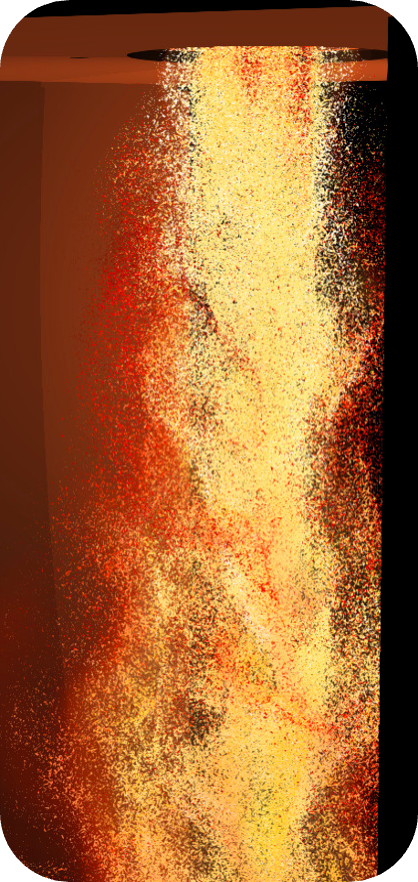
Solid fuels — biomass and, increasingly, reactive metals such as iron and aluminum — offer exciting pathways for carbon-free energy storage and conversion. We advance modeling approaches for reactive multiphase flows, capturing turbulence–chemistry interactions, radiative heat transfer, and solid fuel kinetics to design efficient, low-emission practical applications.
03
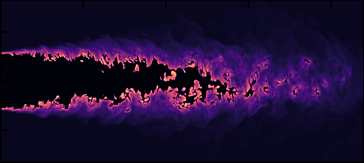
We understand the physics of combustion through Direct Numerical Simulations (DNS) and distill this knowledge into advanced models — flamelet-based manifolds and subgrid-scale closures for Large-Eddy Simulations (LES). Coupled with GPU-based exascale computing, this allows us to investigate complex practical applications, from aero engines to industrial furnaces and chemical reactors.
Our work is characterized by a close connection between fundamental and application-oriented research. Models are validated against experimental data — from lab-scale setups to real devices — in collaboration with experimentalists and industrial partners, and matured to technology readiness levels suitable for industry.
Pillar 1
Model development
Manifold methods and subgrid-scale models for predictive LES.
Pillar 2
Real-world applications
Validation with experimental partners; transfer to industrial configurations.
Pillar 3
HPC innovation
Scalable algorithms for rapidly evolving GPU architectures.
Supported by